Table of Contents
ToggleSpider mites are one of the most frustrating pests you’ll encounter with houseplants, not because they’re complicated to kill, but because they’re easy to miss until the damage is already done. These tiny arachnids thrive in warm, dry indoor conditions, feeding on plant sap and leaving behind stunted growth, webbing, and yellowing leaves. Unlike outdoor garden pests that come and go with the seasons, spider mites can multiply year-round inside your home if left unchecked. The good news? With the right approach, they’re entirely manageable.
Key Takeaways
- Spider mites on indoor plants thrive in warm (70–85°F), dry conditions and can multiply year-round, making early detection essential before visible damage spreads to surrounding houseplants.
- Inspect undersides of leaves weekly and use the tap test with white paper to catch spider mites before webbing appears, as early infestations are far easier to eliminate.
- Combine natural treatments like water sprays, insecticidal soap, and neem oil with repeated applications every 5–7 days to break the mite reproductive cycle across multiple life stages.
- Rotate between different treatment products to prevent spider mites from developing resistance and maintain control over time.
- Prevent infestations by quarantining new plants for two weeks, maintaining 50–60% humidity, improving air circulation, and keeping plants healthy with proper watering and light.
What Are Spider Mites and Why Do They Target Houseplants?
Spider mites are arachnids, relatives of spiders and ticks, not insects. The most common culprit on houseplants is the two-spotted spider mite (Tetranychus urticae), which measures less than 1/50th of an inch. They’re nearly invisible to the naked eye without magnification. You’ll often spot the damage before you see the mites themselves.
These pests pierce plant cells with their mouthparts and suck out chlorophyll, proteins, and moisture. A single female can lay hundreds of eggs in her short lifespan, and in ideal conditions, warm temps (70–85°F) and low humidity (below 50%), populations can explode in less than a week. That’s why indoor plants are especially vulnerable during winter when heating systems dry out the air.
Spider mites don’t discriminate much. They’ll attack a wide range of houseplants, but they have a particular fondness for spider plants, fiddle-leaf figs, English ivy, palms, and dracaenas. Plants already stressed by inconsistent watering, poor light, or nutrient deficiencies are more susceptible. Think of spider mites as opportunists, they move in when your plant’s defenses are already down.
They spread easily. Mites can hitchhike on clothing, tools, or new plants brought into the home. They can also drift on air currents between plants sitting close together. Once they establish a foothold, they’re persistent.
How to Identify Spider Mites on Your Indoor Plants
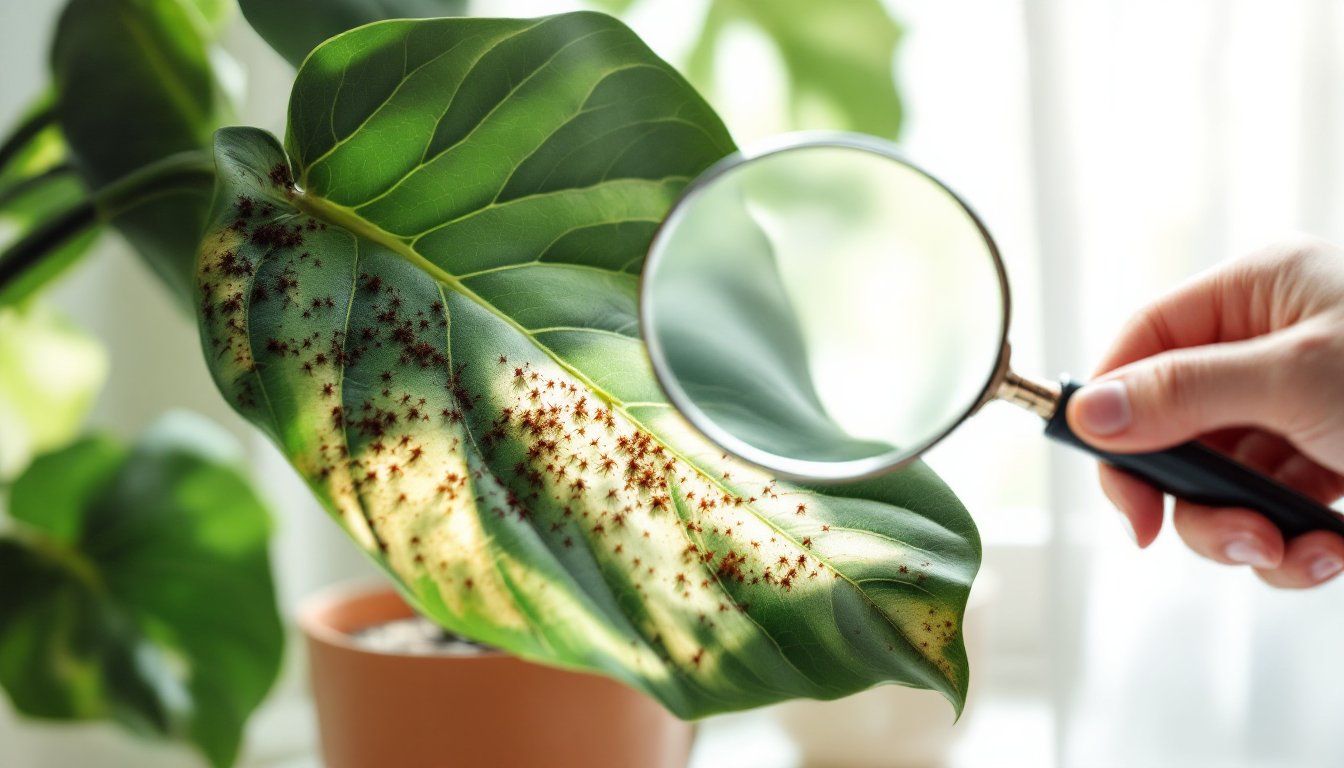
Early detection makes all the difference. By the time webbing appears, you’re already dealing with a significant infestation. Start by inspecting the undersides of leaves, that’s where mites congregate to feed and lay eggs. Use a magnifying glass or your phone’s camera zoom. You’re looking for tiny, moving specks that might be red, brown, yellow, or green depending on the species and what they’ve been eating.
Hold a sheet of white paper under a leaf and tap it gently. If you see tiny dots crawling on the paper, you’ve got mites. This “tap test” is one of the quickest diagnostic tools.
Common Signs and Symptoms of Infestation
Stippling is the earliest visual clue. It looks like tiny yellow, white, or bronze pinpricks on the leaf surface where mites have punctured cells. As feeding continues, leaves lose their green color and take on a dull, dusty appearance.
Webbing is the telltale sign most people recognize. Fine, silky strands appear between leaves, stems, and along leaf edges. It’s not decorative, it’s a protective structure mites use to shield eggs and nymphs from predators and environmental stress. Heavy webbing means the population is well-established.
Leaf damage progresses from stippling to yellowing, browning, curling, and eventual leaf drop. Severe infestations can defoliate a plant entirely. New growth may come in twisted or stunted. Some plants, like roses or hibiscus, develop bronzing on older leaves.
Dusty residue or a gritty texture on leaves can also indicate mite activity, especially if it’s concentrated along veins and the undersides. That’s a mix of shed exoskeletons, egg casings, and fecal matter.
Effective Treatment Methods to Eliminate Spider Mites
Treatment works best when it’s aggressive, repeated, and starts early. Spider mites reproduce faster than most control methods can kill them, so you need to break the cycle by targeting adults, nymphs, and eggs across multiple applications.
Isolate the infested plant immediately. Move it away from other houseplants to prevent spread. Wipe down the area where it was sitting with soapy water.
Natural and DIY Solutions
Water spray is the simplest first-line defense. Take the plant to a sink, tub, or outdoor hose (if weather permits) and blast the undersides of leaves with a strong stream of water. This physically dislodges mites, eggs, and webbing. Repeat every 2–3 days for two weeks. It won’t kill eggs, but it reduces populations and buys you time.
Insecticidal soap is a contact killer that disrupts mite cell membranes. Look for products labeled for spider mites and houseplants (many gardening guides recommend soaps with potassium salts of fatty acids). Spray all leaf surfaces thoroughly, top, bottom, stems, until dripping. Reapply every 5–7 days for at least three cycles to catch newly hatched nymphs. Always test on a small leaf section first: some plants like ferns or succulents can be sensitive.
Neem oil works as both a pesticide and a feeding deterrent. Mix 2 tablespoons of cold-pressed neem oil with a gallon of water and a few drops of dish soap (the soap helps emulsify the oil). Spray every 7 days. Neem has a residual effect but breaks down in sunlight, so it’s better suited for indoor use. Wear gloves: neem can irritate skin.
Rubbing alcohol (70% isopropyl) can be dabbed directly onto visible mites with a cotton swab or diluted 1:1 with water in a spray bottle. It kills on contact but evaporates quickly, so there’s no residual protection. Good for spot treatment on tough-to-reach areas.
Increasing humidity helps slow mite reproduction. Mist plants daily, group them together to create a microclimate, or run a humidifier nearby. Mites struggle when humidity exceeds 60%.
Chemical Control Options
When natural methods aren’t cutting it, or the infestation is severe, miticides are the next step. Horticultural oil (also called superior or summer oil) smothers mites and eggs. It’s low-toxicity and safe for most indoor plants. Apply when temperatures are between 40–85°F and the plant isn’t drought-stressed. Don’t use oil within two weeks of a sulfur treatment or on plants recently treated with insecticidal soap.
Spinosad-based products (derived from soil bacteria) are effective against mites and have low mammalian toxicity. They work by ingestion and contact. Follow label rates carefully, overuse can harm beneficial insects if you ever move plants outdoors.
For persistent infestations, abamectin or bifenthrin miticides may be necessary. These are synthetic and more potent. Use them only as a last resort, and always in a well-ventilated area. Wear gloves, safety goggles, and a respirator if the label recommends it. Never spray near food prep areas or pet zones.
Rotate between different active ingredients. Spider mites develop resistance quickly if you use the same product repeatedly. Alternate between oil, soap, and a miticide if needed. Many experienced gardeners, including those featured in home improvement resources, emphasize rotation as key to long-term control.
Prevention Strategies to Keep Spider Mites Away
Prevention is cheaper and less labor-intensive than treatment. Most infestations are avoidable with a few consistent habits.
Quarantine new plants for at least two weeks before introducing them to your collection. Inspect thoroughly, undersides of leaves, stems, soil surface. Even plants from reputable nurseries can harbor pests.
Maintain humidity. Use a hygrometer to monitor levels. Aim for 50–60% relative humidity around susceptible plants. Pebble trays (a shallow tray filled with water and pebbles, with the pot sitting on top) can help, but they’re less effective than a humidifier in dry climates or winter months.
Regularly inspect plants. Make it part of your watering routine. Check the undersides of a few leaves on each plant every week. Catching mites early, before webbing appears, makes eradication far easier.
Avoid over-fertilizing. Excess nitrogen produces soft, lush growth that mites love. Stick to recommended fertilizer rates and schedules for each plant type.
Space plants appropriately. Good air circulation reduces humidity pockets and makes it harder for mites to jump from plant to plant. Don’t crowd pots together.
Clean leaves periodically. Wipe down smooth-leaved plants with a damp cloth every few weeks. This removes dust, improves photosynthesis, and can dislodge early-stage mite colonies before they establish. For plants with fuzzy or delicate leaves, a gentle shower works better.
Prune damaged foliage. Remove and dispose of heavily infested leaves in a sealed bag, don’t compost them. This reduces the mite population and eliminates hiding spots. Many DIY pest control tips stress sanitation as a cornerstone of prevention.
Introduce beneficial predators if you’re committed to organic control. Phytoseiulus persimilis is a predatory mite that feeds exclusively on spider mites. You can order them online and release them on infested plants. They work best in greenhouses or enclosed grow areas with stable humidity. They won’t establish long-term in typical home conditions, but they can knock down an active infestation.
Finally, keep your plants healthy. Proper watering, adequate light, and appropriate potting mix all strengthen a plant’s natural defenses. Stressed plants emit chemical signals that attract pests. A thriving plant is a less attractive target.